





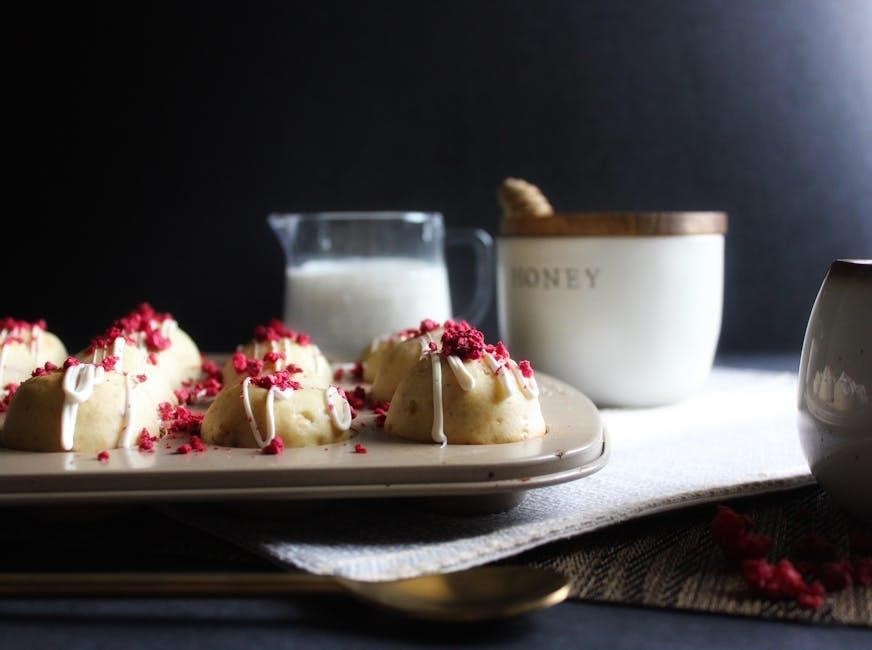
The Rise of Rupi Kaur
Rupi Kaur, a Canadian poet, gained prominence at just 21 with her debut collection, Milk and Honey. Initially self-published in 2014, her work resonated deeply,
becoming a 21st-century poetry bestseller. Her journey began with sharing her work online, attracting a dedicated following and ultimately leading to widespread recognition.
Publication History and Self-Publishing Success
Rupi Kaur’s journey to literary success with Milk and Honey is a compelling narrative of independent publishing. Initially released in 2014, the collection wasn’t launched through traditional channels; instead, Kaur embraced self-publishing, a decision that proved pivotal. She strategically utilized platforms like Tumblr and Instagram to share excerpts, building a devoted online readership before the book even existed in physical form.
This direct engagement with her audience allowed Kaur to cultivate a strong connection with potential readers, bypassing the gatekeepers of conventional publishing. The initial print run was modest, funded by her savings and the support of her family. However, word-of-mouth, fueled by social media shares and genuine emotional resonance, quickly propelled Milk and Honey into the spotlight.
The book’s success wasn’t immediate, but it steadily grew, eventually attracting the attention of Andrews McMeel Publishing, who re-released the collection in 2017. This partnership broadened its reach, but the foundation of its popularity was undeniably laid through Kaur’s initial self-publishing efforts and savvy online presence. The story of Milk and Honey is a modern testament to the power of independent creation and the evolving landscape of book publishing.
Exploring Themes of Love and Loss

Milk and Honey by Rupi Kaur delves deeply into the complex and often painful experiences of love, loss, and the journey towards self-discovery. The collection doesn’t shy away from portraying the raw vulnerability associated with romantic relationships, exploring both the intoxicating highs and the devastating lows. Kaur examines the multifaceted nature of love – encompassing not only passionate connection but also familial bonds and self-love.
Loss permeates the work, manifesting as heartbreak, grief, and the struggle to let go. She confronts the aftermath of trauma, depicting the emotional scars left by broken trust and shattered expectations. However, the exploration of loss isn’t solely focused on despair; it’s intertwined with themes of resilience and the potential for healing.
Kaur’s poetry often presents love and loss as cyclical experiences, suggesting that pain can be a catalyst for growth and self-awareness. The collection ultimately offers a message of hope, emphasizing the importance of embracing vulnerability and finding strength within oneself, even amidst profound emotional turmoil. It’s a candid portrayal of the human heart’s capacity for both immense joy and enduring sorrow.
Addressing Trauma and Healing
Milk and Honey by Rupi Kaur is profoundly impactful in its direct confrontation with trauma and its subsequent journey towards healing. The collection doesn’t offer simplistic solutions, but rather a raw and honest depiction of the long and arduous process of recovery. Kaur fearlessly explores the lasting effects of painful experiences, acknowledging the emotional and psychological scars they leave behind.
The poetry delves into themes of abuse, violence, and the struggle to reclaim agency after experiencing harm. She portrays the complexities of navigating these difficult emotions, including anger, shame, and self-doubt. However, the work isn’t solely focused on the pain of trauma; it also emphasizes the importance of self-compassion and self-care.
Kaur’s verses offer a space for readers to acknowledge their own pain and begin the process of healing. She suggests that vulnerability is a strength, and that sharing one’s story can be a powerful act of resistance and empowerment. Ultimately, Milk and Honey presents a message of hope, reminding readers that healing is possible, even after experiencing profound trauma.
Discussion of Abuse and Violence
Rupi Kaur’s Milk and Honey unflinchingly addresses the sensitive and often silenced topics of abuse and violence. The collection doesn’t shy away from depicting the harsh realities of these experiences, offering a voice to survivors and challenging societal norms surrounding victim-blaming. Kaur explores various forms of abuse – emotional, physical, and sexual – with a vulnerability that resonates deeply with readers.
Her poetry portrays the isolating nature of abuse, the feelings of powerlessness, and the long-lasting impact on self-worth. She doesn’t offer graphic details, but rather focuses on the emotional and psychological consequences, allowing readers to connect with the pain on a visceral level. The work also examines the complexities of relationships where abuse occurs, highlighting the cycles of manipulation and control.
Importantly, Kaur’s exploration of these themes isn’t solely about recounting trauma; it’s also about reclaiming agency and finding strength in the aftermath. She emphasizes the importance of self-love, boundaries, and seeking support. Milk and Honey serves as a powerful testament to the resilience of the human spirit in the face of adversity.
The Role of Femininity and the Female Experience
Rupi Kaur’s work centers the female experience, exploring themes of menstruation, sexuality, and relationships with raw honesty. She reclaims femininity, challenging patriarchal norms and celebrating female strength and vulnerability.
Style and Form of Rupi Kaur’s Poetry
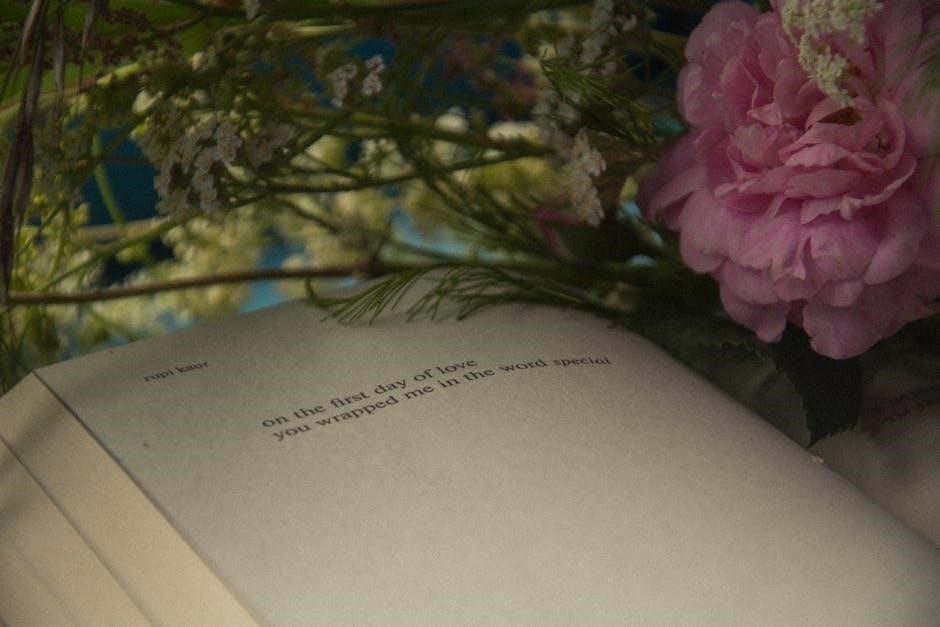
Rupi Kaur’s poetic style is remarkably distinctive, characterized by its minimalist approach and accessibility. Her verses are often short, fragmented, and presented in lowercase, eschewing traditional poetic conventions like complex rhyme schemes or elaborate metaphors. This deliberate simplicity contributes to the immediacy and emotional impact of her work, allowing readers to connect with the raw vulnerability expressed within.
A defining feature of Kaur’s poetry is the integration of her own illustrations alongside the text. These simple, often monochromatic drawings aren’t merely decorative; they function as integral components of the poems, visually amplifying the emotional weight and thematic concerns. The combination of text and image creates a multi-layered experience, enhancing the overall artistic expression.
The rise of social media, particularly Instagram, played a pivotal role in shaping Kaur’s style and reaching a vast audience. Initially gaining traction by sharing her poems as images on the platform, she harnessed the power of visual storytelling and direct engagement with her followers. This fostered a sense of community and allowed her work to bypass traditional literary gatekeepers, directly resonating with readers seeking authentic and relatable content.
Her style, while praised for its accessibility, has also been subject to debate, with some critics questioning its adherence to established poetic forms. Nevertheless, its impact on contemporary poetry is undeniable, inspiring a new generation of poets to experiment with form and embrace personal narratives.
Minimalist Poetry and Short-Form Verse
Rupi Kaur’s poetry is fundamentally defined by its minimalism. She deliberately strips away traditional poetic elements – complex rhyme schemes, intricate meter, and elaborate figurative language – to create a style that is stark, direct, and emotionally resonant. This isn’t a rejection of poetic skill, but rather a conscious choice to prioritize raw honesty and accessibility.
The short-form verse that characterizes Milk and Honey is a key component of this minimalist aesthetic. Poems often consist of just a few lines, sometimes even single words or phrases, presented in lowercase. This brevity forces a concentrated focus on the core emotion or idea being conveyed, maximizing impact with minimal verbiage.
This approach resonates particularly strongly with a contemporary audience accustomed to the concise communication of social media. The poems feel like fragments of thought, intimate confessions, or snapshots of experience, mirroring the way many people express themselves online.
Critics have noted the influence of haiku and other forms of concise poetry on Kaur’s work, but her style is ultimately unique, blending poetic tradition with a distinctly modern sensibility. The simplicity isn’t merely stylistic; it’s integral to the emotional power of her verses.
Use of Illustrations and Visual Elements
Rupi Kaur doesn’t confine her artistic expression to words alone; Milk and Honey is notably integrated with her own simple, yet powerful, illustrations. These aren’t elaborate artworks, but rather delicate line drawings that complement and amplify the emotional weight of her poetry. The illustrations aren’t merely decorative; they function as an extension of the poetic voice, adding another layer of meaning and interpretation.
Often, the drawings depict the female form, frequently in vulnerable or symbolic poses. These visual representations reinforce the themes of body image, trauma, and healing that are central to Kaur’s work. The minimalist style of the illustrations mirrors the minimalist style of her poetry, creating a cohesive aesthetic throughout the book.
The combination of text and image creates a multi-sensory experience for the reader, enhancing emotional engagement. The visual elements provide moments of respite from the intensity of the poems, while simultaneously deepening their impact.
This integrated approach demonstrates Kaur’s versatility as an artist and her understanding of how different mediums can work together to convey complex emotions and experiences.
Impact of Social Media on Kaur’s Style

Rupi Kaur’s rise to prominence is inextricably linked to the power of social media, particularly Instagram. Before Milk and Honey became a published book, Kaur built a substantial following by sharing her poetry and illustrations directly with audiences online. This direct connection allowed her to bypass traditional gatekeepers in the publishing industry and cultivate a loyal readership.
Instagram’s visual nature heavily influenced Kaur’s style. The platform favored concise, visually appealing content, which led to her development of short-form poetry and the integration of simple illustrations. The character limits and emphasis on imagery encouraged her minimalist aesthetic.
Furthermore, the platform provided immediate feedback and engagement with her audience, shaping her artistic direction. The viral spread of her work, including a piece addressing menstruation that was briefly removed by Instagram, brought her further attention and sparked conversations about censorship and female representation.
Social media wasn’t just a promotional tool; it was integral to the creation of her style and the building of her community.
The Book’s Popularity and Commercial Success
Milk and Honey by Rupi Kaur achieved remarkable commercial success, becoming one of the best-selling poetry books of the 21st century. Initially self-published in 2014, the book’s popularity grew organically through word-of-mouth and social media, eventually attracting the attention of Andrews McMeel Publishing.
The book resonated with a broad audience, particularly young women, who connected with its themes of love, loss, trauma, and healing. Its accessible style and relatable content contributed to its widespread appeal. The availability of PDF versions, while raising copyright concerns, likely further expanded its reach.
Milk and Honey spent 77 weeks on the New York Times bestseller list, a testament to its enduring popularity. It has been translated into numerous languages and sold millions of copies worldwide. Kaur’s success demonstrated a shift in the publishing landscape, proving the viability of self-publishing and the power of direct engagement with readers.
The book’s commercial triumph paved the way for a new generation of poets and challenged traditional notions of what poetry could be.
Criticism and Controversy Surrounding the Work
Despite its immense popularity, Rupi Kaur’s Milk and Honey has faced significant criticism. Some critics argue that the poetry lacks complexity and depth, labeling it as simplistic and overly sentimental. Concerns have been raised regarding the originality of her work, with accusations of borrowing heavily from other poets and traditions.
The accessibility of PDF copies online has fueled debates about copyright infringement and the devaluation of artistic work. While increasing readership, unauthorized distribution undermines the author’s financial compensation and control over her creation.
Early controversy surrounded Kaur when Instagram removed a photograph depicting her menstrual stains, sparking discussions about censorship and body image. This incident, however, arguably contributed to her visibility and solidified her image as a boundary-pushing artist.
Further criticism centers on the commercialization of trauma and the potential for the work to be misinterpreted or misused. Despite these critiques, Kaur’s impact on contemporary poetry remains undeniable, prompting ongoing dialogue about art, accessibility, and authenticity.
Influence on Contemporary Poetry
Rupi Kaur’s Milk and Honey profoundly impacted contemporary poetry, particularly among younger audiences. Her success demonstrated the viability of self-publishing and the power of social media in reaching readers directly, bypassing traditional publishing gatekeepers.
The book’s minimalist style and accessible language encouraged a new wave of poets to experiment with form and content, prioritizing emotional honesty and personal narrative. The widespread availability of PDF versions, while raising copyright concerns, undeniably broadened her reach and inspired countless aspiring writers.
Kaur normalized the inclusion of personal experiences – trauma, love, loss – in poetry, fostering a more inclusive and relatable literary landscape. Her influence extends to the visual presentation of poetry, integrating illustrations and a distinctive aesthetic.
While debated, her work sparked conversations about the definition of poetry itself, challenging conventional norms and opening doors for diverse voices. She paved the way for a generation of “Instapoets,” proving that poetry could be both commercially successful and deeply personal.
Availability of the Book in Physical Form
Despite the prevalence of PDF versions circulating online, Milk and Honey by Rupi Kaur enjoys widespread availability in traditional physical formats. Initially self-published, the book was later picked up by Andrews McMeel Publishing, leading to mass-market distribution.
Readers can readily purchase Milk and Honey at major booksellers like Barnes & Noble, Amazon, and independent bookstores globally. It’s commonly found in paperback, offering an affordable option for a broad audience. Hardcover editions are also available, often marketed as collector’s items or gifts.
The book’s consistent presence on bestseller lists ensures continued restocking and availability. Various editions have been released, including special covers and anniversary prints, catering to different preferences.
Better World Books also offers physical copies, contributing to literacy initiatives with each purchase. The enduring demand for a tangible copy demonstrates that, despite digital accessibility, many readers still value the experience of holding and reading a physical book.
Digital Editions and E-books
Alongside physical copies, Milk and Honey by Rupi Kaur is widely accessible in digital formats. Major e-book retailers, including Amazon Kindle, Apple Books, and Kobo, offer the book for purchase and immediate download.
These e-book versions provide convenience and portability, allowing readers to access the poetry on various devices – smartphones, tablets, and e-readers. The digital format often includes features like adjustable font sizes and built-in dictionaries, enhancing the reading experience.
While unauthorized PDF copies circulate online, purchasing the official e-book supports the author and publisher. The availability of legitimate digital editions ensures a high-quality reading experience, free from potential viruses or formatting issues associated with unofficial downloads.
Furthermore, platforms like the Internet Archive offer access to digitized versions, though availability may vary. The widespread adoption of e-readers and the convenience of digital libraries have contributed to the continued popularity of Milk and Honey in its electronic form.
PDF Versions and Online Access (Including Telegram Channels)
Numerous websites and platforms, including Telegram channels like amharic_bookss, offer PDF versions of Milk and Honey. However, accessing these may raise copyright concerns.

Copyright and Legal Considerations
Copyright Information (2015 by Rupi Kaur): Milk and Honey is protected under copyright law, with all rights reserved to Rupi Kaur since its original publication in 2015. This legal protection extends to the entire work, including the poems, illustrations, and the overall arrangement of the book. Unauthorized reproduction, distribution, or adaptation of the content is a violation of these rights.
Legality of Downloading PDF Copies: Downloading PDF copies of Milk and Honey from unofficial sources is generally considered illegal. While readily available on various websites and platforms, including those shared via links on Telegram, these downloads often infringe upon the author’s copyright. Purchasing the book through legitimate channels – such as bookstores or authorized digital retailers – ensures compliance with copyright law and supports the author’s work.
Ethical Considerations Regarding Book Piracy: Beyond the legal ramifications, downloading pirated copies raises significant ethical concerns. Authors rely on book sales for their livelihood, and piracy directly undermines their ability to continue creating. Supporting authors by purchasing their work demonstrates respect for their artistic efforts and contributes to a sustainable literary ecosystem. Choosing legal avenues to access Milk and Honey is a responsible and ethical choice, fostering a culture that values creativity and intellectual property.
Copyright Information (2015 by Rupi Kaur)
Rupi Kaur retains full copyright ownership of Milk and Honey, initially established in 2015. This encompasses all aspects of the work – the poetic text, accompanying illustrations, the book’s structural design, and the overall creative expression. Copyright law grants exclusive rights to the author, controlling reproduction, distribution, adaptation, and public display of the material.
The copyright notice, frequently found within the book itself and associated publishing information, explicitly states “Copyright © 2015 by Rupi Kaur.” This serves as a public declaration of her ownership and a legal warning against unauthorized use. Any reproduction, whether creating PDF copies, sharing excerpts online without permission, or adapting the work for other purposes, constitutes a copyright infringement.
Understanding copyright is crucial when considering access to Milk and Honey. While online availability is widespread, including numerous unofficial PDF downloads, these often violate Kaur’s legal rights. Supporting the author through legitimate purchases – physical books or authorized digital editions – respects her intellectual property and contributes to her continued creative endeavors.
Legality of Downloading PDF Copies
Downloading PDF copies of Milk and Honey from unauthorized sources is generally illegal. Copyright law protects Rupi Kaur’s work, granting her exclusive rights to its distribution. Obtaining the book through unofficial channels, such as websites offering “free downloads” or file-sharing platforms, constitutes copyright infringement, a violation of legal statutes.
While the internet provides easy access to numerous PDF versions, these are often distributed without the author’s consent or the publisher’s authorization. Engaging in such downloads exposes individuals to potential legal risks, though prosecution of individual downloaders is relatively rare. However, the act itself remains unlawful and undermines the author’s right to benefit from her creative work.
Legitimate access to Milk and Honey involves purchasing the book through authorized retailers – bookstores, online vendors like Amazon, or official digital platforms offering e-books. These purchases directly support Rupi Kaur and ensure compliance with copyright regulations. Choosing legal avenues demonstrates respect for intellectual property and contributes to a sustainable ecosystem for authors and publishers.
Ethical Considerations Regarding Book Piracy

Book piracy, including PDF sharing of Milk and Honey, devalues Rupi Kaur’s creative labor. It deprives her of income and discourages future artistic endeavors, impacting the entire literary community.
Further Exploration of Rupi Kaur’s Work
Beyond Milk and Honey, Rupi Kaur demonstrates a multifaceted artistic vision. She’s not solely a poet; her creative output extends significantly into photography and broader artistic projects, often interwoven with the themes explored in her writing. Her Instagram presence, a crucial platform for her initial rise, continues to be a vibrant space for connecting with fans and sharing glimpses into her creative process.
Kaur actively engages with her audience, fostering a community around her work. This digital engagement isn’t merely promotional; it’s a dialogue, a space for vulnerability and shared experiences mirroring the core of her poetry. Her photography often complements her poetic themes, visually representing the emotions and narratives present in her verses. It’s a holistic approach to storytelling, blending words and images to create a richer, more immersive experience for her readers.
While Milk and Honey propelled her to fame, exploring her wider body of work reveals a consistent artistic voice and a dedication to exploring complex emotions. The readily available PDF versions, though raising copyright concerns, have ironically broadened access to her art, introducing her work to a wider audience and fueling further discussion and appreciation.
Kaur’s Photography and Artistic Projects
Rupi Kaur’s artistic expression extends far beyond the realm of poetry, encompassing a compelling body of photographic work. Her images aren’t simply standalone pieces; they are intrinsically linked to the emotional core of her writing, often serving as visual counterparts to the themes explored in Milk and Honey and subsequent collections. These photographs frequently feature self-portraits, raw and vulnerable, mirroring the honesty and openness that define her poetic style.
Kaur utilizes photography as another avenue for exploring femininity, trauma, and healing – recurring motifs in her work. The visual medium allows her to convey emotions and narratives in a different, yet complementary, way to her poetry. Her artistic projects demonstrate a deliberate aesthetic, often characterized by minimalist compositions and a focus on the human form.
The accessibility of her work, including widely circulated PDF copies of Milk and Honey, has undoubtedly contributed to the broader appreciation of her photographic endeavors. Fans encountering her poetry often seek out her visual art, recognizing it as an integral part of her overall artistic vision and a deeper understanding of her creative world.
Social Media Presence and Engagement with Fans

Rupi Kaur’s ascent to literary fame is inextricably linked to her strategic and authentic use of social media, particularly Instagram. She initially gained attention – and faced censorship – when an image depicting menstrual blood was removed by the platform, sparking a conversation about body image and online censorship. This incident, ironically, propelled her into the spotlight and fostered a strong connection with her audience.
Kaur consistently shares excerpts from her poetry, alongside her photography and illustrations, directly engaging with fans. This direct line of communication allows for immediate feedback and a sense of community. The widespread availability of PDF versions of Milk and Honey, while raising copyright concerns, also fueled online discussions and sharing, further amplifying her reach.
She actively responds to comments and messages, creating a personalized experience for her followers. Her social media presence isn’t merely promotional; it’s a space for vulnerability, support, and shared experiences, solidifying her role as a relatable and inspiring figure for a generation. This consistent engagement has been pivotal in sustaining her popularity and fostering a loyal fanbase.